
In today’s fast-paced and ever-evolving marketplace, businesses are constantly seeking the most effective ways to reach their target audience. Two broad marketing approaches dominate this landscape: traditional marketing and digital marketing. While both aim to connect businesses with consumers and drive sales, their methods, reach, and effectiveness differ vastly. This blog explores both strategies in detail, compares their strengths and limitations, and helps businesses understand which method—or combination—might work best for them.
Table of Contents
- Introduction
- What is Traditional Marketing?
- What is Digital Marketing?
- Key Differences Between Traditional and Digital Marketing
- Channels of Traditional Marketing
- Channels of Digital Marketing
- Pros and Cons of Traditional Marketing
- Pros and Cons of Digital Marketing
- Cost Comparison
- Measurability and Analytics
- Reach and Targeting
- Customer Engagement
- Trust and Brand Perception
- Industry-Wise Suitability
- When to Use Traditional Marketing
- When to Use Digital Marketing
- Combining Both Approaches: Integrated Marketing
- Case Studies of Success
- Trends and Future of Marketing
- Conclusion
1. Introduction
Marketing is the heartbeat of any successful business. It’s not just about advertising; it’s about creating connections, building brand identity, and converting leads into loyal customers. Over time, marketing strategies have evolved from newspapers and billboards to SEO and social media. As the world grows increasingly digital, many wonder if traditional marketing is still relevant. This blog breaks down both approaches to give a complete picture.

2. What is Traditional Marketing?
Traditional marketing refers to the conventional methods used by companies to promote products and services before the rise of the internet. This includes:
- Print media (newspapers, magazines)
- Broadcast (TV, radio)
- Outdoor advertising (billboards, banners)
- Direct mail (flyers, brochures)
- Telemarketing (cold calls)
Traditional marketing focuses on a one-way communication model, where brands push their messages to the audience without real-time interaction.
3. What is Digital Marketing?
Digital marketing involves marketing efforts conducted through digital platforms, particularly the internet. Key elements include:
- Search engine optimization (SEO)
- Social media marketing
- Email marketing
- Content marketing (blogs, videos, infographics)
- Pay-per-click advertising (PPC)
- Influencer marketing
Digital marketing allows for two-way communication, audience segmentation, and real-time feedback.
4. Key Differences Between Traditional and Digital Marketing
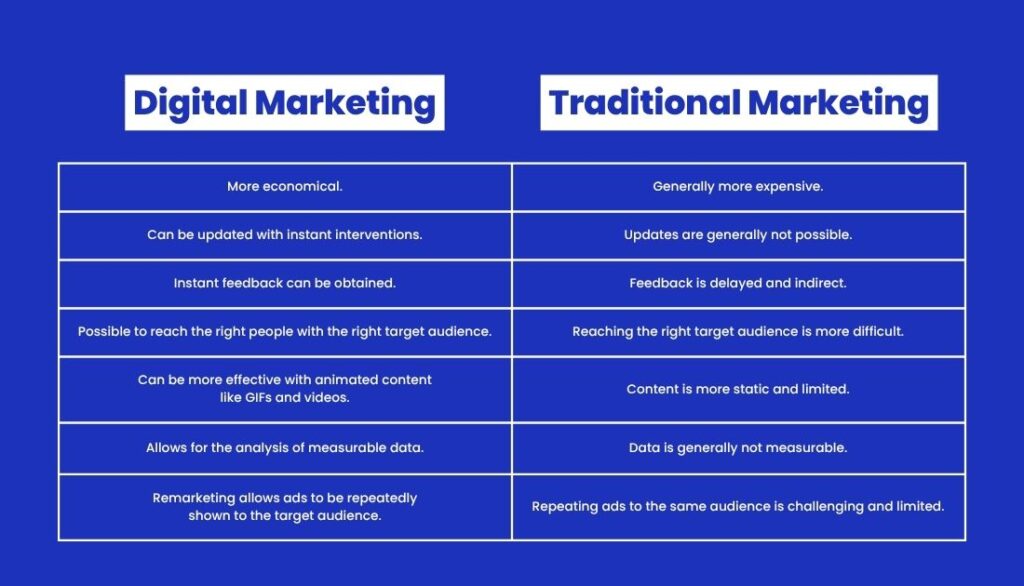
| Aspect | Traditional Marketing | Digital Marketing |
|---|---|---|
| Media Used | Print, TV, radio, billboards | Websites, social media, email |
| Interaction | One-way | Two-way |
| Audience Reach | Local to national | Global |
| Cost | Usually expensive | Often cost-effective |
| Measurement | Difficult to track | Real-time tracking |
| Customization | Generalized messages | Highly targeted and personalized |
5. Channels of Traditional Marketing
- Television and Radio – Mass communication with strong audio-visual impact.
- Print Advertising – Newspapers, magazines, brochures for local marketing.
- Billboards and Hoardings – High-visibility, impactful advertising.
- Direct Mail – Flyers, coupons, and postcards sent physically.
- Event Marketing – Roadshows, sponsorships, and exhibitions.
6. Channels of Digital Marketing
- Search Engines (SEO, SEM) – Improve website visibility and paid ad placements.
- Social Media Platforms – Facebook, Instagram, LinkedIn, YouTube, etc.
- Email Campaigns – Personalized marketing messages.
- Content Marketing – Blogs, videos, podcasts, and infographics.
- Mobile Marketing – SMS, push notifications, app-based ads.
7. Pros and Cons of Traditional Marketing
Pros:
- Tangible: Physical ads can be kept or revisited.
- Wide reach: Great for reaching a non-digital audience.
- Strong brand recall: Especially for visual ads on TV or billboards.
- Effective in rural or less tech-savvy regions.
Cons:
- Costly: High production and media buying costs.
- Hard to measure: Difficult to know the ROI.
- Less engaging: No real-time interaction with audience.
- Limited customization: Generic message to a broad audience.
8. Pros and Cons of Digital Marketing
Pros:
- Targeted reach: Custom campaigns for specific demographics.
- Cost-effective: Suitable for all budget sizes.
- Measurable: Analytics tools offer real-time performance data.
- Interactive: Engage customers via likes, comments, shares.
- Flexible: Easily editable and updatable campaigns.
Cons:
- Requires technical knowledge.
- Can be overwhelming due to fast-changing platforms.
- Privacy concerns and ad blockers may limit reach.
- Internet dependency may exclude some users.
9. Cost Comparison
Traditional marketing, especially TV and print ads, can require a huge upfront investment. On the other hand, digital marketing offers flexible budgeting, allowing startups and small businesses to compete with larger players.
For example:
- A 30-second TV ad in prime time might cost ₹5-10 lakhs.
- A Facebook or Google ad campaign can start at ₹500.
10. Measurability and Analytics
Digital marketing wins this round clearly. With tools like Google Analytics, Facebook Insights, and email marketing reports, every click, view, and conversion can be tracked.
In contrast, traditional campaigns rely on indirect metrics like survey feedback, which can be subjective and delayed.
11. Reach and Targeting
Traditional marketing usually reaches a broad audience. However, this often includes many people not interested in the product.
Digital marketing allows precise targeting based on:
- Age
- Location
- Interests
- Online behavior
This leads to higher ROI and better conversion rates.
12. Customer Engagement
Digital marketing is interactive and personalized. It lets brands respond to customers, collect feedback, and build long-term relationships.
Traditional marketing lacks this real-time engagement, which can make customers feel unheard.
13. Trust and Brand Perception
Traditional marketing often builds higher trust. A newspaper or TV ad gives the impression of a credible, established brand.
Digital marketing can sometimes feel less trustworthy, especially when audiences are flooded with spam and fake ads. However, consistent branding and valuable content can overcome this.
14. Industry-Wise Suitability
Traditional Marketing Works Best For:
- FMCG (Fast Moving Consumer Goods)
- Luxury Brands
- Real Estate
- Local retail stores
Digital Marketing Works Best For:
- Tech companies
- E-commerce platforms
- Education and training
- Service-based businesses (coaches, freelancers, agencies)
15. When to Use Traditional Marketing
- Launching a local store or branch
- Targeting older demographics
- Running a political or public campaign
- Participating in offline events or exhibitions
16. When to Use Digital Marketing
- Promoting online services or products
- Building brand awareness
- Reaching a younger, internet-savvy audience
- Conducting remarketing campaigns
- Gathering email lists or generating leads
17. Combining Both Approaches: Integrated Marketing
Many successful brands today use a hybrid strategy called integrated marketing. It combines the power of traditional media with the flexibility of digital platforms.
Example:
- A TV ad campaign drives viewers to visit a website or use a QR code.
- A newspaper ad promotes an Instagram contest.
This dual strategy ensures maximum exposure and customer engagement.
18. Case Studies of Success
Case Study 1: Amul India
Amul has blended traditional billboard ads with engaging digital content, such as memes and social commentary on social media. This keeps them relevant across generations.
Case Study 2: Zomato
Zomato uses witty digital content across Instagram and Twitter, but also advertises on billboards and newspapers for wide visibility.
Case Study 3: Coca-Cola
Globally, Coca-Cola invests heavily in TV and outdoor advertising but runs equally strong digital campaigns for seasonal promotions and user-generated content.

19. Trends and Future of Marketing
- AI and Automation: AI tools are revolutionizing customer targeting and content creation.
- Influencer Marketing: A digital-only trend growing rapidly in all industries.
- Voice Search Optimization: Emerging digital frontier.
- Nostalgia Marketing: Traditional methods blended with digital storytelling.
As customer behavior continues to shift online, digital marketing will grow. However, traditional media won’t disappear—it will evolve and complement digital tools.
20. Conclusion
In conclusion, both traditional and digital marketing have their unique strengths. Traditional marketing builds trust, offers broad reach, and remains effective in many regions and industries. Digital marketing, however, brings speed, targeting, real-time interaction, and detailed analytics.
The most successful marketing strategy is often not choosing one over the other, but rather knowing how to use both effectively based on your business goals, audience, and budget.
Whether you’re a small business owner or a large enterprise, understanding these two strategies helps you build a smarter, more effective marketing plan in today’s hybrid world.
Would you like me to turn this into a visually engaging blog post with headings, images, or infographics for your website or a PDF version?
Ask Chat
nswer in chat instead
👉